As outlined in the whitepaper, validators who join DoubleZero receive filtration and connectivity services. But those can be made more concrete in the case of Solana, where DoubleZero offers six types of improvements.
- Slot Times: DoubleZero pairs with the validator client improvements to offer a pathway to lower slot times, on two fronts. Most directly, dedicated connectivity lowers both the latency and jitter of information transmission, by replacing inefficient and random routing with direct and deterministic routing. More subtly, however, DoubleZero — by virtue of the capacity on the network — can offer more creative solutions, such as multicast propagation of blocks or wider Turbine fan-out.
- Block Size: While Solana block sizes have recently migrated to 60 million compute units, a dramatic step change (e.g. a doubling, tripling, or more of block size) remains difficult. Anza’s article On the Road to 1M TPS states: “as blocks grow significantly in terms of bytes, the median block distribution time can start exceeding 400ms for certain workloads.” However, DoubleZero has the bandwidth capacity to circulate blocks that are orders of magnitude larger, removing at least one bottleneck to larger blocks.
- Voting: Latency matters acutely for voting, which in turn reduces the time to finality. The status quo, in which timely vote credits are awarded fully for votes that happen within two slots of the block, works well — but that cutoff was set to allow for a full second of latency via the public internet (when in fact the roundtrip latency around the globe is a seventh of that). DoubleZero can offer lower latency, which both means that votes will naturally accumulate faster and timely vote credits can potentially reward next-slot voting only.
- Geographic Reach: Validators today struggle to operate in regions like South America, Africa, and Australia, due to substantial latency of the public internet. Indeed, approximately half of Solana’s stake is in London, Amsterdam, and Frankfurt. By offering direct connectivity, DoubleZero makes operating in some of these frontier locations more viable, allowing Solana to decentralize further.
- RPCs and MEV Participants: Much of the infrastructure surrounding the validator set can benefit from DoubleZero, and that infrastructure can generate more value for users and validators alike. More predictable delivery from RPCs allows for more timely (and thus more valuable) transactions to reach the leader. Lower latency from searchers and the Jito block engines allows for more valuable trades and bundles to reach the leader.
- Filtration: in the future, DoubleZero may filter away transactions that are duplicated or that have malformed signatures at common ingress points using bespoke hardware, which is important the performance of the Agave and Firedancer clients. Anza in that same article identifies that the current Agave client, which schedules transactions “after other expensive operations such as signature verification,” is vulnerable to wasting effort on a flood of incorrectly-signed packets. Moreover, data from a set of validators running the Frankendancer client (including Staking Facilities, Asymmetric Research, RockawayX, Cogent Crypto, and Trillium) shows that some 75% of inbound transactions (as measured from epochs 726 - 750) are duplicates.
These advantages get further magnified by features like future multicast, where the network — rather than the validator — does replication of packets. This alone reduces latency and conserves bandwidth; but more critically, it can transform certain systems like Turbine — moving it from the status quo, i.e. a waterfall of shreds sent out in sequential steps, to a simpler and faster model, where the block is transmitted a single time and reaches all validators on the most direct path.
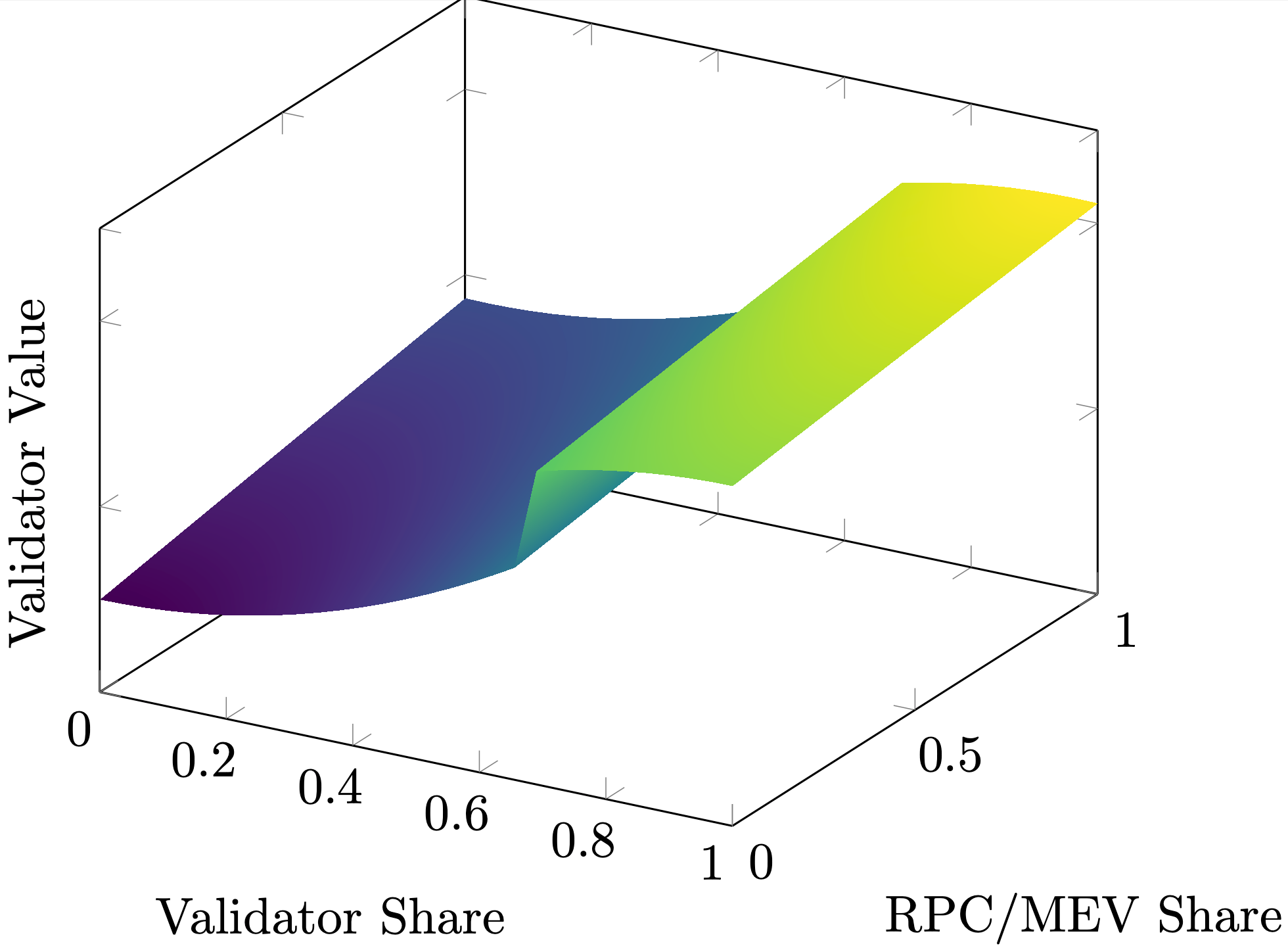
The six improvements can be combined into a more abstract visualization, which plots the value accruing to a single validator as a function of the share of the validator network and the share of the RPC/MEV ecosystem on DoubleZero.
This visualization summarizes various scenarios. For instance, if no validators or RPC/MEV participants are on DoubleZero, an incremental validator would still receive some baseline value from filtration. As validators join the system, the value to an incremental validator grows: it sends and receives blocks faster, and can potentially expand into new regions. There is a critical step change at 2/3 of the stake, where the protocol itself can make certain changes (e.g. shorter slot times or larger blocks) safely. Separately, suppose there are no validators on DoubleZero but RPC/MEV participants join instead. The incremental validator benefits from better delivery of these systems, which offer more priority fees and MEV rewards, and this is a fairly linear increase. Put together, the following visualization sketches out the entire value curve to a validator across these two dimensions, where light colors are higher than dark colors.