

This is the origin story of DoubleZero and its three co-founders: Austin, Mateo, and Andrew.
Blockchain has never been a “small idea.” From the original Bitcoin whitepaper in 2008, the goal has always been one of societal change expressed through an economic paradigm shift. To produce monumental change, we have to start by rethinking legacy systems, including traditional financial rails. The mission since inception has been to wean society from the control and comfort of existing gatekeepers, and build tooling that enables globally distributed self-sovereign systems to exist in a digital age.
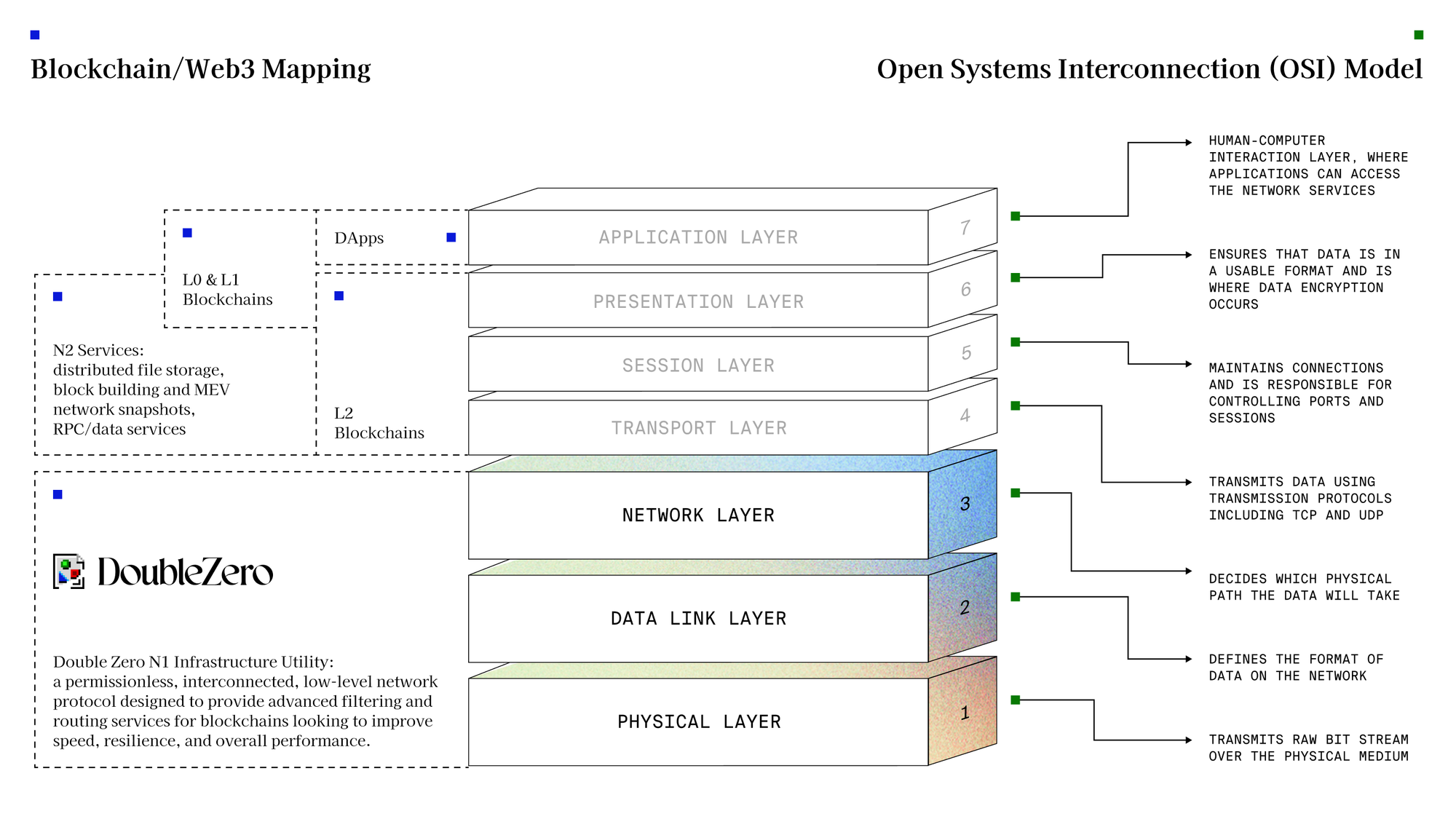
The industry to date has spent its time optimizing code, software programs and compute up the technical stack. We’ve pushed abstractions upward with L2s, appchains, but very few teams have ever looked under the hood, below the blockchain itself. Few have considered the physical network layer in which blockchains operate outside of the abstract, which ultimately determines their performance potential, and the freedom of a system.
In the fall of 2024, three individuals from three separate worlds: crypto, telecommunications, and high-frequency trading converged around a single understanding:
To build a network that performs like Wall Street, scales like the internet, and remains open like blockchain, you have to merge worlds that have never crossed paths before.
This is the story of those three paths, and how they became one ambitious project called: DoubleZero.
Crypto | Austin Federa
Blockchain’s earliest breakthroughs weren’t about speed; they were about coordination. Provable solutions to the byzantine general’s problem allowed a fundamental rethink of how digital systems could be built. Satoshi’s real innovation was showing that thousands of strangers, spread across the world, could agree on a single shared truth without having to trust one another. That idea unlocked everything that followed: validator incentives, proof-of-stake, fault-tolerant consensus, adversarial game theory, and increasingly sophisticated scheduling logic. These ideas became the foundation of the modern crypto ecosystem. It’s important to recognize that almost none of these ideas were “net new” but instead emergent from a combination of existing technologies and a social movement capable of envisioning an alternative future.
But buried inside those breakthroughs was a quiet assumption: that the public internet underpinning it all would somehow keep up.
In most blockchain designs, the network (in the classical sense of switches, routers, and fiber) is treated as something you can fix later, as if better software or optimizations up the stack will eventually make things fast enough.
Austin learned at Solana that this assumption doesn’t hold - at least not for execution. Even with one of the fastest blockchains in the world, performance was still capped by the public internet itself. When validator messages move over slow, unpredictable routes, no software optimization can overcome that physical limit.
No matter how elegant the consensus algorithm is, it can only move as fast as the network connecting its validators. Amdahl’s law: a system is only as fast as its slowest part.
Somewhere along the way, the public internet has become the bottleneck. When messages are forced to travel over slow, unpredictable, multi-hop paths chosen for cost efficiency rather than timing guarantees, the system’s limits are set before a single block is even produced. But, when we optimize from the bottom up, we accelerate everything above. Coordinating untrusted machines is hard. Coordinating them quickly, with millisecond-level expectations and adversarial conditions, is an entirely different problem.
Austin’s insight distilled the gap clearly:
“Blockchain taught us how to coordinate thousands of untrusted machines, but it never taught those machines how to communicate fast.”
Consensus is more than computation; it’s also communication.
Today, every blockchain relies on the public internet to do that communication, a network never designed for precise timing, optimized performance, or real-time global coordination. As long as blockchains remain bound to infrastructure built for email, web pages, and video streaming, their theoretical breakthroughs will always be constrained by very physical limits.
Decentralization and performance can’t be traded off forever. If decentralized systems can’t operate fast enough, they stop being competitive with the centralized systems they set out to replace. To scale decentralization, the network itself has to scale with it. Enter: DoubleZero.
Telecom | Mateo Ward
While blockchain engineers spend their days working with abstract state machines and consensus diagrams, telecommunications engineers confront the physical realities of transporting bits across vast geographic distances. Mateo came from that second world, where fiber routes, routing policy, congestion domains, weather patterns, and interconnection agreements matter far more than idealized models of how the internet “should” work.
One of the first realities you learn in telecom is that the internet is not a single, coherent network: it is a federation of thousands of privately operated backbones, telecom carriers, ISPs, and cloud providers connected through business agreements that can abstract engineering principles. Packets do not take the shortest path, nor the most efficient path, nor the path best suited for a validator or a trading engine. They take the path that is cheapest for the networks carrying them. This is not a design flaw; it is by design.
Blockchain, in its eagerness to treat the internet as an abstraction layer, rarely acknowledges how dramatic these physical differences can be. A validator in Tokyo communicating with a validator in Paris might experience 5x or 10x variations in latency depending on how their carriers decide to route traffic that day. Consensus traffic is mixed with video streaming, gaming, enterprise workloads, and ordinary consumer chatter. The result is unpredictability, jitter, packet loss, and multi-hop detours; conditions fundamentally incompatible with deterministic coordination.
Mateo’s conclusion was blunt:
“If you expect decentralized systems to operate with high performance, you cannot rely on generic transit paths. They need a dedicated backbone designed for what they are actually doing.”
This is not a matter of preference; it is an architectural necessity. Without a purpose-built network layer that prioritizes determinism, direct routing, and low congestion, crypto’s performance ceiling will remain permanently capped by infrastructure designed for content delivery rather than global consensus and it will be continuously exposed to malicious distributed denial of service (DDoS) attacks.
Capital Markets | Andrew McConnell
There is one industry that recognized the power of purpose-built networks decades ago: high-frequency trading. In HFT, the difference between winning and losing is measured not in seconds or milliseconds, but in microseconds and nanoseconds. The public internet was already known to be too slow and unpredictable as electronic traders began hooking up their computers to trade on various electronic exchanges in the late 1990s. HFT firms never even attempted to use the public internet and instead invested in purpose-built, dedicated infrastructure between the data centers where exchange matching engines were positioned and their own internal quantitative research environments.
Private fiber routes were constructed between financial centers. Point-to-point wireless networks were erected to minimize propagation delay. Switching hardware was tuned so tightly that adding a meter of cable required justification. Specialized FPGAs and ASICs were positioned in the infrastructure to eliminate latency tails introduced by even the most optimized software systems. Determinism was not just a design goal, it was required to survive as spreads tightened and the proverbial “race to zero” was on.
After years of designing these highly optimized dedicated networks at traditional financial exchanges and for high-frequency traders, Andrew brought his expertise into the open world of decentralized systems, where blockchain performance has historically been treated as a secondary concern or a “nice-to-have.” His perspective made the gap glaring: the systems blockchains dream of building like internet capital markets based on global real-time state machines, decentralized exchanges with institutional liquidity, and networks capable of competing with traditional financial infrastructure, are completely incompatible with the performance characteristics of the public internet.
His analogy captures the reality:
“Relying on the public internet for high-performance systems is like expecting 19th-century mail routes to handle modern logistics. DoubleZero is what happens when you stop sharing roads and start building dedicated infrastructure rails.”
In HFT and traditional finance, performance is the baseline. In blockchain, performance has been an afterthought. This mismatch prevents entire categories of applications from emerging and limits the ambitions of ecosystems long before developers ever encounter protocol-level bottlenecks. Andrew’s contribution is the insistence that determinism, low latency, and predictable routing are not luxuries, they are table stakes for the next era of decentralized systems.
The Convergence of Three Roads into One Network
What is striking about these three worlds is not their differences, but the extent to which they converge when tasked with the same problem: how to build a global coordination network that is decentralized, performant, and reliable under all conditions.
- From blockchain, we inherit the logic of open coordination and permissionless participation.
- From telecom, we inherit the understanding of how data actually moves across the planet and the engineering realities that determine its speed.
- From capital markets, we inherit the discipline of precision, determinism, and the design culture that treats performance as a constraint rather than an afterthought.
These paths rarely intersect in the real world. Yet when accelerating alongside one another, they drive toward the same unavoidable conclusion: a new network layer is needed, one that sits beneath blockchains, exchanges, and distributed systems, providing a dedicated high-performance backbone for the workloads of the future.
This is the conceptual foundation of DoubleZero.
Blockchain has never suffered from a lack of imagination; it has suffered from a lack of grounding. We have built increasingly complex financial systems on top of networks that cannot support the types of global coordination and real-time execution those systems aspire to achieve. As a result, the industry has often mistaken surface-level innovation for foundational progress.
The next stage of blockchain’s evolution will come from building a network backbone that takes the physical realities of timing, distance, routing, and determinism seriously enough to design for them directly rather than outsourcing them to a patchwork of consumer internet paths (ISPs). Internet Capital Markets require a backbone that integrates the lessons of blockchain, telecom, and high-frequency trading rather than treating them as separate worlds.
The most important shift is philosophical: rather than accepting the public internet as an immutable constraint, DoubleZero acknowledges that infrastructure for distributed systems must evolve downward, into the physical layer, if the systems built on top are to ever achieve their full potential.