


DoubleZero’s Mainnet-Beta is now live. Launched October 2nd, it marks a major leap from controlled testing to full-scale production and coincides with the public launch of the 2Z token, the SPL token that powers the network. More than 70 high-performance links across 25+ global locations — contributed by independent providers including Jump, RockawayX, Distributed Global, Latitude, Teraswitch, Galaxy, Cherry Servers, Staking Facilities, South 3rd Ventures, Jito and Cumberland/DRW — now form a backbone purpose-built for speed and reliability. This new infrastructure delivers deterministic, low-latency routing for high-throughput, distributed systems. It has been shaped and validated by actual validator operations during testnet and Mainnet-Alpha.
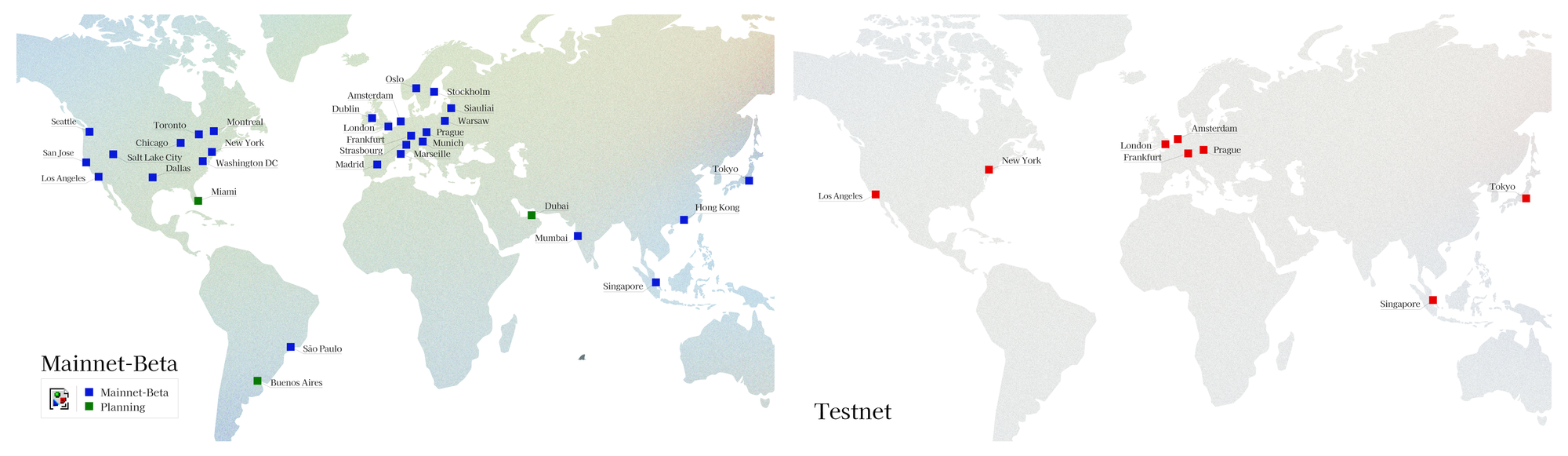
This launch caps a staged rollout designed to push DoubleZero under real conditions before opening to the broader ecosystem. Early testnet operations ran with a limited footprint to deliberately stress-test routing, redundancy and failover. On September 15th the network advanced to Mainnet-Alpha, a limited-access production environment where validators joined in cohorts to validate performance at scale, collect telemetry and integrate improvements ahead of public launch.
That preparation has already produced measurable results. In Mainnet-Alpha epoch 24, 77 percent of active links and 82 percent of measured city-pair routes outperformed the public internet, proving that a dedicated transport layer can deliver meaningful latency gains before public launch. [Full performance details from Mainnet-Alpha are available here.]
Why Performance-Focused Connectivity Matters
Blockchains and other distributed systems rely on thousands of nodes coordinating in real time. The public internet, while remarkable, was built for reach and general-purpose traffic, not consensus-critical workloads. Packets are routed according to carrier priorities and intermixed with unrelated flows such as video streaming and advertising. This can result in congestion and constrained protocol performance.
DoubleZero provides a purpose-built alternative: a neutral, chain-agnostic network of dedicated high-performance links engineered for low-latency consensus and sustained throughput, bringing predictable performance to distributed systems at scale.
Inside the DoubleZero Network
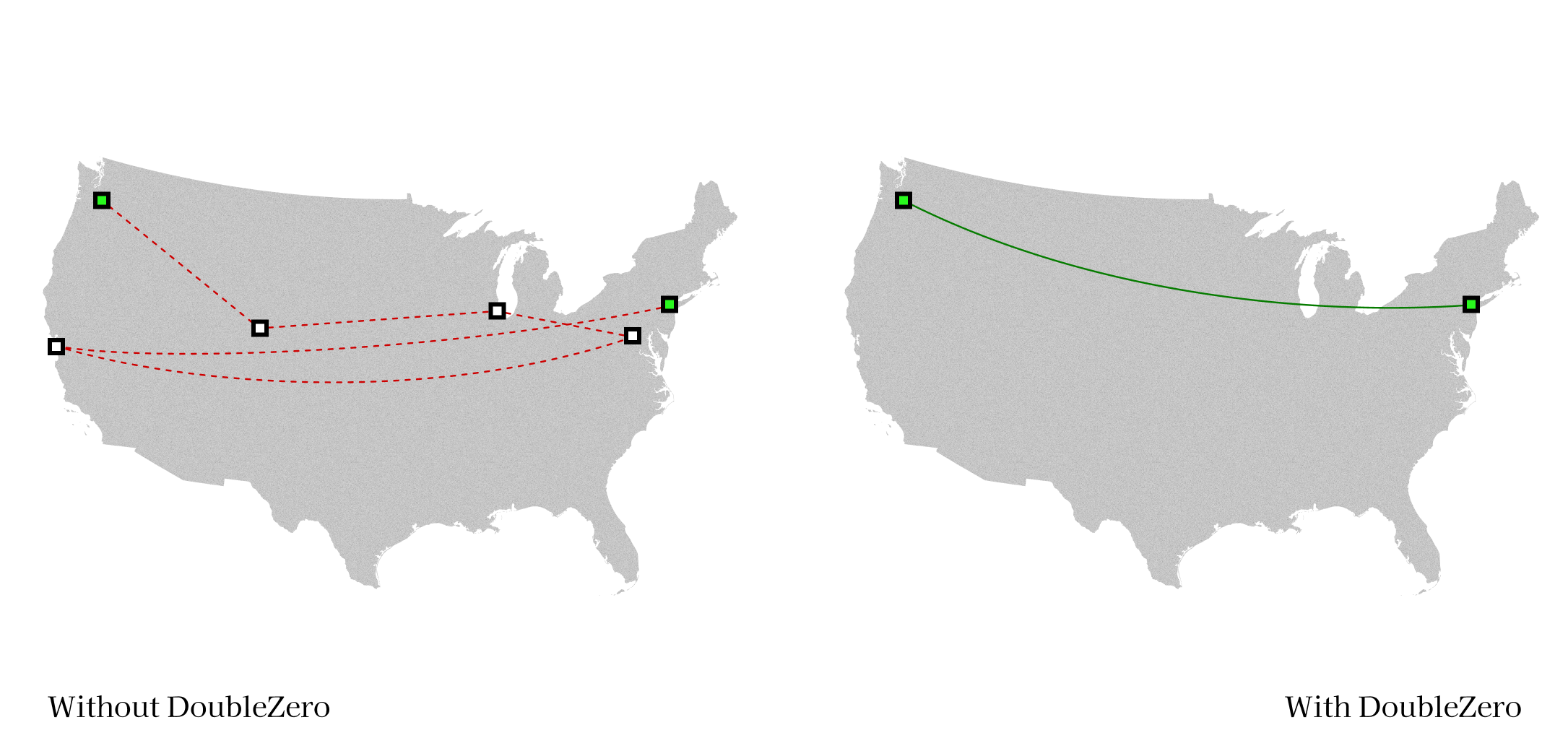
DoubleZero is a high-performance global network made up of independently contributed fiber links, managed by an on-chain control plane and optimized for deterministic routing. Whereas the public internet sends packets across multiple, often unpredictable hops, DoubleZero steers validator traffic over contributor-provided direct routes from origin to destination. This predictable path shortens propagation time, reduces latency and jitter and delivers the consistency and resilience that consensus-critical workloads require.
IBRL Mode: Increase Bandwidth, Reduce Latency
IBRL Mode is the default way validators, RPCs and users connect to DoubleZero. It overlays contributor-provided links without requiring validator reconfiguration. Traffic is encapsulated at the edge, routed over high-performance paths and exits near peers or block producers to reduce propagation time. In short, it “just works,” delivering measurable latency and bandwidth gains automatically.
Benefits of DoubleZero Networking
- Reach: High-performance connectivity extends to underserved regions.
- Flexibility: No need to add a second network interface.
- Faster Performance: Shorter, more direct routes reduce latency.
- Resilience: Multiple independent paths protect against outages.
- Fair Rewards: Fees go to operators who contribute measurable improvements.
- Integrity: Transparent, verifiable performance strengthens trust.
Real-time latency metrics for all active routes can be seen on the Performance Dashboard.
Powering the Network with the 2Z Token
2Z is the native SPL token of DoubleZero. It powers payments, staking, and contributor rewards — aligning validators, stakers, and bandwidth providers into a single performance-driven economy.
Launch Parameters
- Supply: 10 billion 2Z tokens at genesis
- Inflation and Burn: Modest inflationary minting rewards contributors, while partial burns preserve integrity and disincentivize artificial traffic
Core Utility
- Payments for high-performance connectivity
- Staking to support system security and operations
- Rewards tied to real-time value creation
This Proof of Utility design ensures rewards are allocated by incremental contribution, not raw volume — helping prevent centralized capture.
Detailed information on how 2Z powers the network on the DoubleZero Token Economics page.
Regulatory Clarity
2Z is the subject of a first-of-its-kind No-Action Letter from the SEC’s Division of Corporation Finance. The letter confirms that 2Z does not need to register as a class of equity securities, and that programmatic flows of 2Z on the DoubleZero network are not securities transactions. This clarity underscores what makes DePIN models unique: tokens are distributed as functional incentives for real-world infrastructure contributions, not as speculative instruments. The decision gives participants confidence that they can engage with DoubleZero under a clear, supportive regulatory framework.
Community at the Core
DoubleZero is a performance-driven network built and maintained by its participants.
- Validators run high-quality nodes that secure the Solana network and directly benefit from faster propagation, lower latency and stake delegation through the DoubleZero Delegation Program.
- Contributors register endpoints and fiber links that deliver verifiable improvements over the public internet and earn 2Z rewards tied to uptime, latency and throughput.
- Stakers delegate dzSOL to support route verification and reward calculation, adding economic weight to the system.
- Token holders supply liquidity and facilitate payments for high-performance connectivity across the network.
Core engineering contributors have also been central to Mainnet-Beta’s development. Malbec Labs provides software development and network engineering services to DoubleZero and was one of the earliest technology contributors to the network. Jump Crypto has contributed software, hardware, and substantial network bandwidth since the project’s inception. Additional engineering contributions have come from Anza and Jito Labs, strengthening the foundation for production-grade deployment.
The DoubleZero Delegation Program
DoubleZero has established a 13 million SOL stake pool to accelerate validator growth and performance across the Solana ecosystem. In its first phase, delegations are awarded to Solana validators actively connected to DoubleZero’s Mainnet-Beta network. Allocations are based on validator performance, commission rate, and length of time on the network, rewarding early adopters who help test and refine DoubleZero ahead of full production launch.
Phase Two: Prioritizing Geographic Diversity As DoubleZero moves beyond launch, the Delegation Program will shift its focus toward rewarding validators in historically underrepresented regions. This next phase is designed to strengthen Solana decentralization by supporting operators where high-performance connectivity has not previously been viable. Validators in these regions will have dedicated pathways to apply for and receive stake, creating new economic incentives for a more geographically balanced network.
How to Qualify Today
- Run a Solana mainnet validator.
- Connect to DoubleZero Mainnet-Beta.
Delegations are reviewed regularly, with geographic criteria playing an important role as Phase Two rolls out.
What’s Next
Multicast Delivery (Fall 2025)
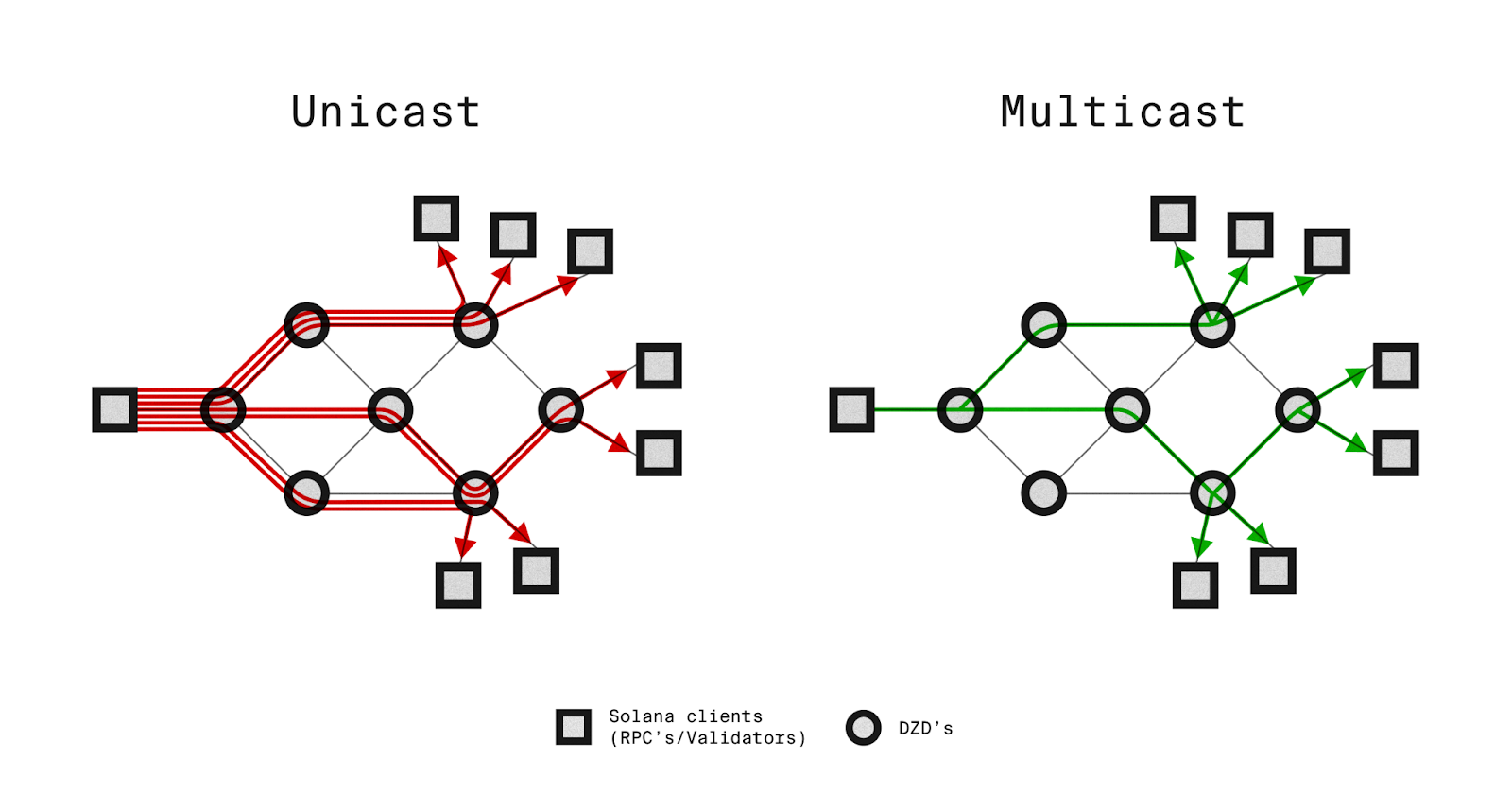
Most blockchain networks still rely on unicast for block and state propagation, sending separate copies of the same data to each peer. DoubleZero multicast sends a primary and redundant stream that is replicated once inside the network and delivered in parallel to all recipients.
Edge Filtration (2026)
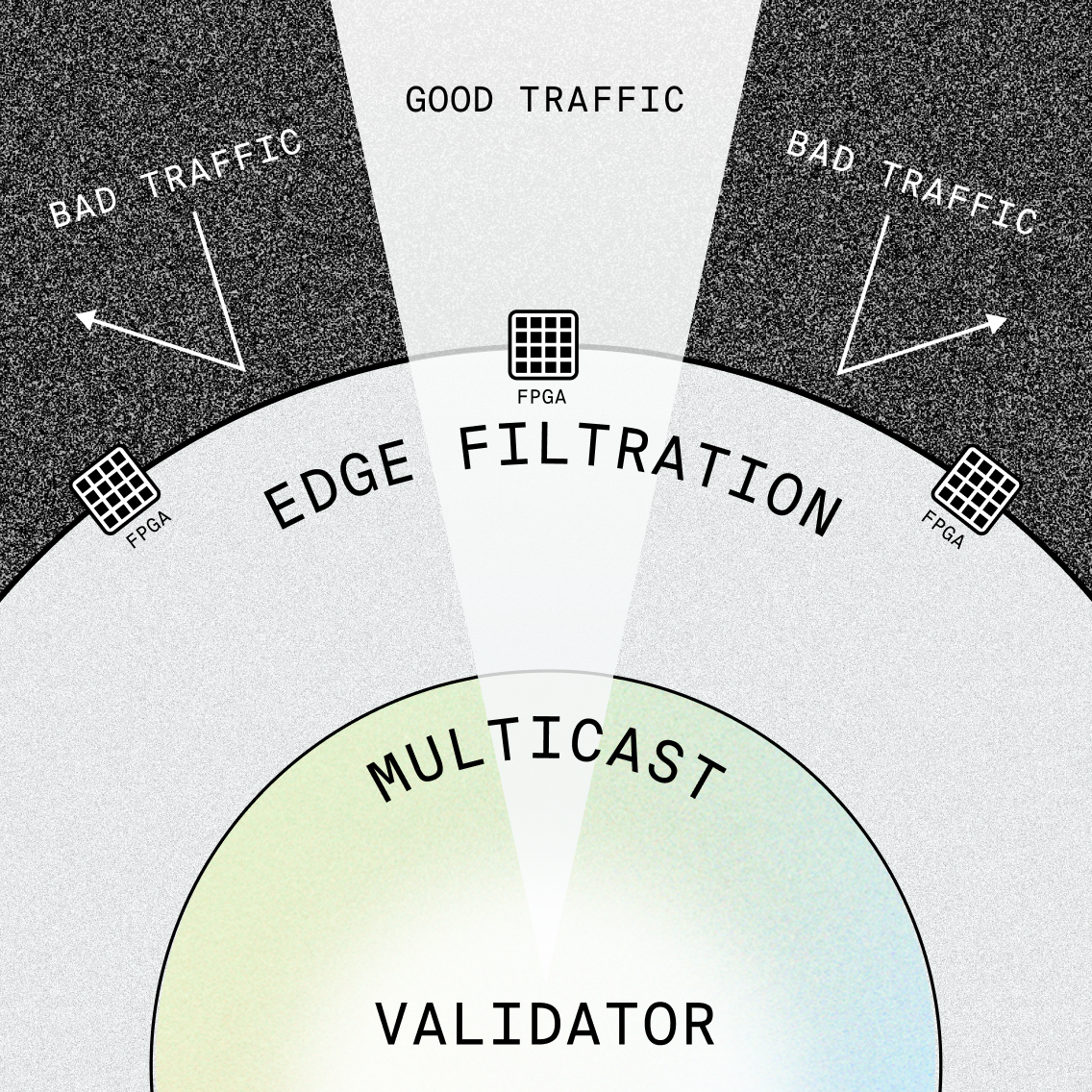
FPGA-powered packet filtering at ingress moves intensive defense tasks such as spam removal, packet deduplication and signature verification from validator CPUs to dedicated hardware at DoubleZero ingress points. This offloading preserves validator performance even under high inbound traffic, filtering malicious or redundant packets at line speed without added latency.
Ways to Participate
There are three main ways to get involved right now:
- Solana Validators: Connect to DoubleZero Mainnet-Beta and benefit from low-latency, high-bandwidth routing. [Connect]
- Stakers: Stake dzSOL and help support network growth. [Stake]
- Contributors: Register fiber endpoints and links to earn rewards based on measurable performance. [Contribute]
Building a Fast, Fair Internet
Mainnet-Beta marks a major milestone toward a high-performance, decentralized backbone for distributed systems. Whether operating a validator, contributing bandwidth or staking dzSOL, participation helps shape the next era of blockchain infrastructure.