

Overview
With the upcoming launch of DoubleZero’s mainnet-beta network, now is the best time to analyze DoubleZero’s testnet. Testnet was always designed for testing rather than performance. But nevertheless, we can ask: did validators perform better on it?
Surprisingly and happily, the answer is yes. By running on DoubleZero’s testnet, validators earned 1.4% more vote credits and their rate of skipped slots dropped 0.37 percentage points, accounting for selection effects. We believe this is due to the lower variation in the latency of shred and vote delivery, as DoubleZero’s testnet is markedly more stable than the public internet.
DoubleZero plans to make mainnet-beta publicly available on October 2, 2025. Unlike testnet, the links on mainnet-beta are explicitly designed for performance. Unlike testnet, the infrastructure covers a much wider set of cities. And unlike testnet, mainnet-beta aims to leverage network effects from a much wider set of validators, RPCs, searchers, Jito engines, and others. These promising results from testnet make us hopeful that we will find larger and more wide-ranging effects for the validators on mainnet-beta.
A Primer for Testnet
Despite it being a testing environment, DoubleZero testnet has welcomed and served Solana mainnet validators since it launched in March until now. However, it substantially grew at the end of July with the rollout of the DoubleZero Delegation Program; and it has been shrinking since mid-September as validators move on to test different components of the mainnet-beta network directly. As such, the analysis will focus on that core period, which corresponds to Solana epochs 820 - 847. Moreover, at its peak, some 231 mainnet Solana validators representing 16.7% of the stake, i.e. 67 million SOL, were on DoubleZero’s testnet.
DoubleZero’s testnet is comprised of links from two contributors between eight cities (Frankfurt, Amsterdam, London, Los Angeles, New York, Prague, Singapore, and Tokyo). These links are not necessarily much faster than the public internet, but — as private links — they are meant to be much more stable. To illustrate, consider below the sample of round-trip latency measurements for the links, benchmarked against the public pathway, both for the mean and p99 (i.e. 99th percentile) value. While testnet is faster in many cases, it is not necessarily faster in all cases. However, the mean and p99 values for testnet links are remarkably similar whereas they vary more for the public internet routes. Public pathways suffer congestion and time-varying routing that private pathways do not.
| City #1 | City #2 | Testnet Latency (mean) | Testnet Latency (p99) | Public Latency (mean) | Public Latency (p99) |
| AMS | LON | 5.76ms | 5.83ms | 18.78ms | 19.92 ms |
| FRA | LON | 11.07ms | 11.38ms | 7.91ms | 8.47ms |
| LAX | NYC | 68.41ms | 68.47ms | 64.2ms | 66.01ms |
| LAX | TYO | 98.76ms | 98.81ms | 103.24ms | 104.75ms |
| LON | NYC | 67.3ms | 67.36ms | 102.63ms | 126.46ms |
| LON | SN | 154.36ms | 154.55ms | 252.34ms | 253.88ms |
| SIN | TYO | 67.2ms | 67.27ms | 72.2ms | 75.44ms |
Note that unlike testnet, DoubleZero’s upcoming mainnet-beta network does aim to be uniformly faster than the public internet, in addition to being more stable. Indeed, network contributors only earn rewards on their links if the pathways are more performant than the public pathways.
Estimating the Effect of Testnet
Returning to the original question, the easiest — but most misleading — way to assess the performance of DoubleZero testnet is to just compare cohorts. That is, we can compare skip rates and vote credits for DoubleZero testnet adopters to non-adopters. As an example, consider the following plot for vote credits.
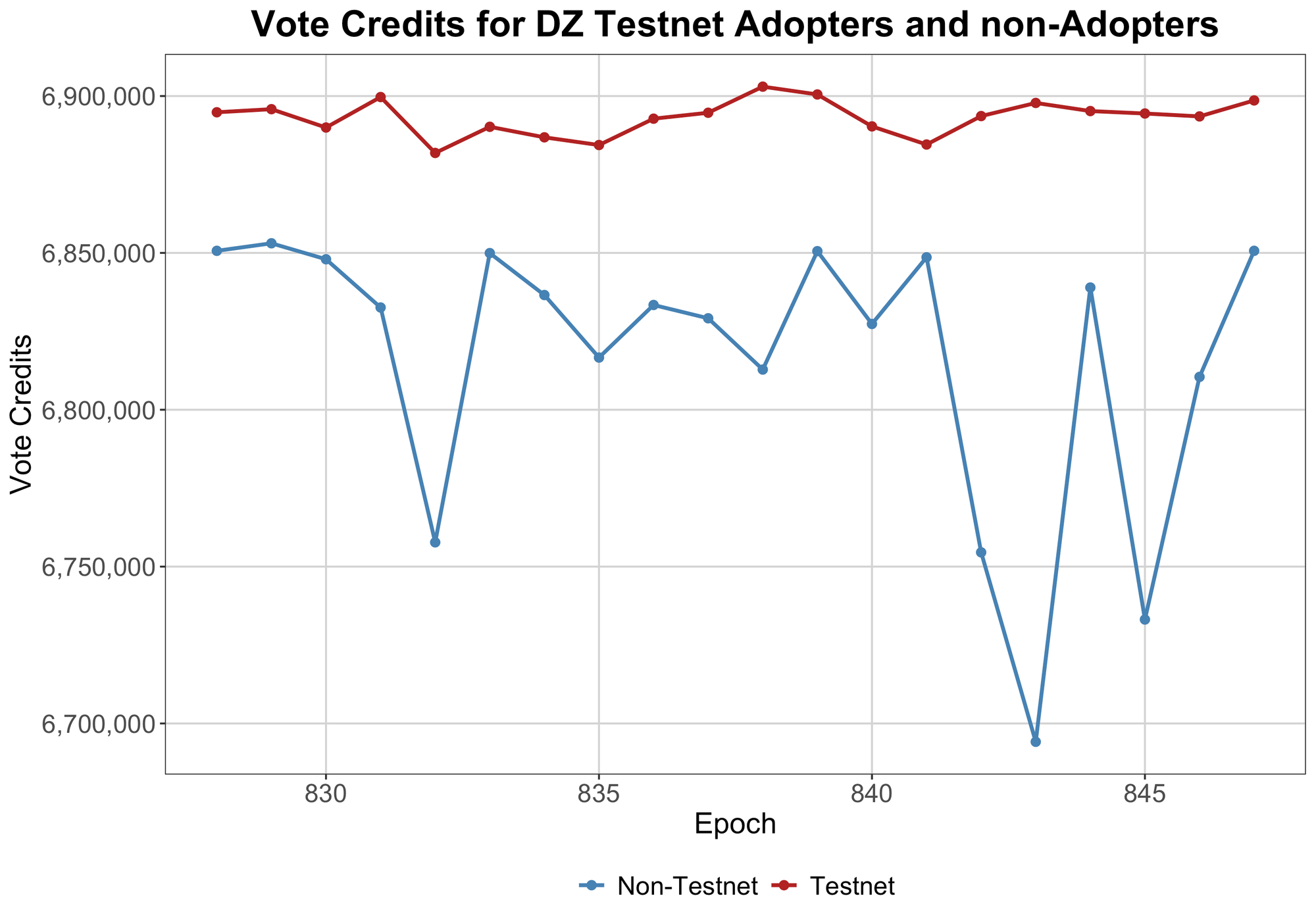
The plot is immediately problematic, as it makes clear that there is a large issue with selection effects. DoubleZero testnet adopters are simply better validators than non-adopters, and would have lower skip rates and more vote credits even without DoubleZero ever coming into existence. The plot shows that the time series of vote credits earned by testnet adopters is just secularly higher than that of non-adopters, even at the start of the time interval when very few of the adopters were actually on DoubleZero.
The solution is to adjust each validator against its baseline, so that we are comparing changes in validators rather than levels. In the economics literature, this is known as a fixed effects regression, and it strongly mitigates selection issues.1 The equation to estimate the effect of testnet is below, where a response variable y is regressed on a treatment indicator for a given validator i in epoch t on whether it has joined testnet or not, along with a set of validator-level and epoch-level fixed effects.
Under this methodology, it no longer matters that DoubleZero selects for good validators. The methodology now looks to see that those good validators got better when joining DoubleZero.
The Testnet Boost
With this methodology, we can now robustly measure the effect of testnet on two response variables:
- Skip Rates: DoubleZero testnet lowers the skip rate of its adopters by 0.37 percentage points (at the 5% significance level). This is large quantitatively, as the mean skip rate is only 0.48% per epoch over this period; skips are generally rare events. Thus, in relative terms, DoubleZero testnet lowers skip rates by 77%.
- Vote Credits: DoubleZero testnet raises the vote credits of its adopters by 1.4% (at the 0.1% significance level). In quantitative terms, the mean number of vote credits earned by a validator per epoch over this period is 6.84 million and so DoubleZero testnet brings an extra 97,000 vote credits to its adopters.
Both of these response variables are robust to different sub-samples and minor variations of the regression specification. We study other response variables too, but find either no effect or no effect that survives robustness checks.2
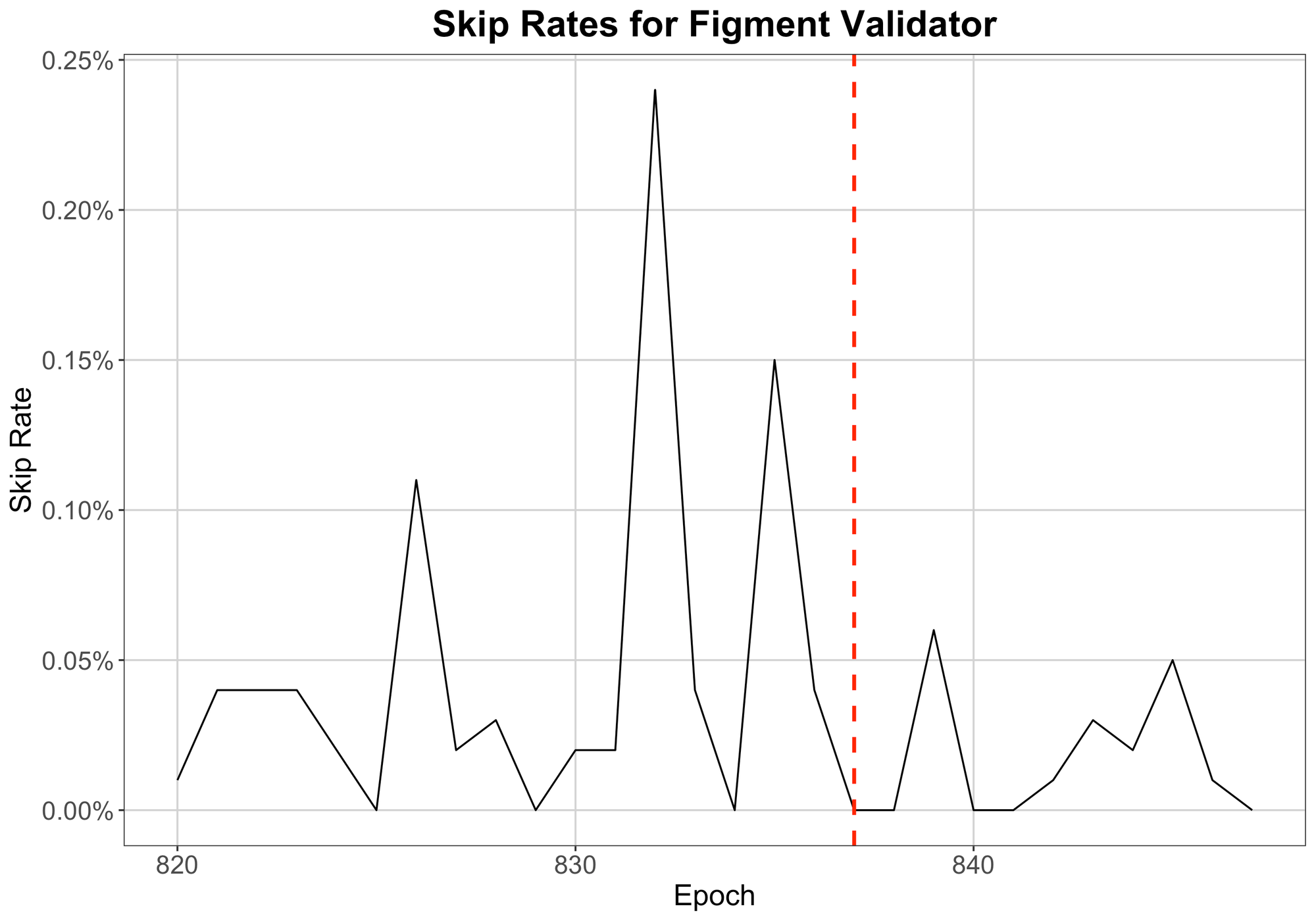
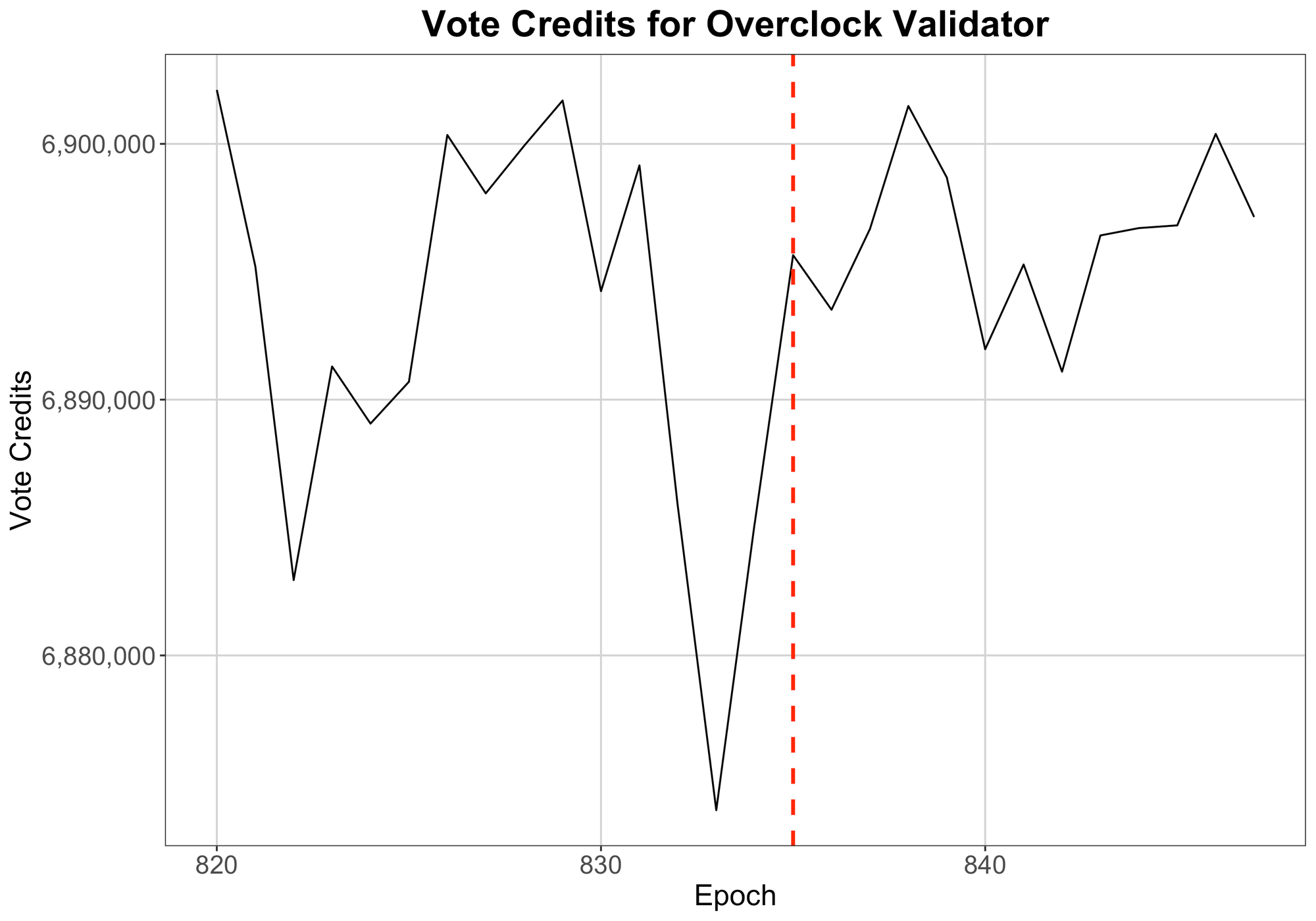
To reiterate, these are treatment effects that come out of an implicit comparison of a validator to itself, i.e. the post-testnet validator to the pre-testnet validator. To visualize this, consider two examples: skip rates for the Figment validator and vote credits for the Overclock validator. While the series are noisy, they generally show the right treatment effects: Figment’s skip rates fall after joining DoubleZero and Overclock’s vote credits rise after joining DoubleZero testnet. These sorts of patterns — averaged over the hundreds of validators who joined DoubleZero testnet at different times — are what allow us to estimate a causal treatment effect precisely.
The final open question is why? It is hard to know for sure, but we suspect that the reliability of DoubleZero testnet compared to the public internet drives the results. Vote credits and skipped slots on Solana are optimized for some amount of delay, e.g. vote credits are awarded in full for votes that arrive up to two slots after a block is produced and slots are only skipped if a supermajority fails to vote on it in time. But occasionally the public internet impairs delivery beyond this, whereas DoubleZero’s testnet does not. The stability offered by DoubleZero eliminates the handful of extreme outliers in connectivity, and we believe this drives the estimated effects.
Endnotes
[1] One could still argue that there is still selection in this methodology, e.g. validators chose to join DoubleZero testnet when they were making other improvements to their operations. While possible, this strikes us as much less plausible. The primary impetus to join testnet over this period was stake delegation from the DoubleZero Delegation Program.
[2] We collect a variety of response variables per validator per epoch from the Trilium API.